
Concert Review
Tchalik String Quartet (Quatuor Tchalik) – 12th January 2026
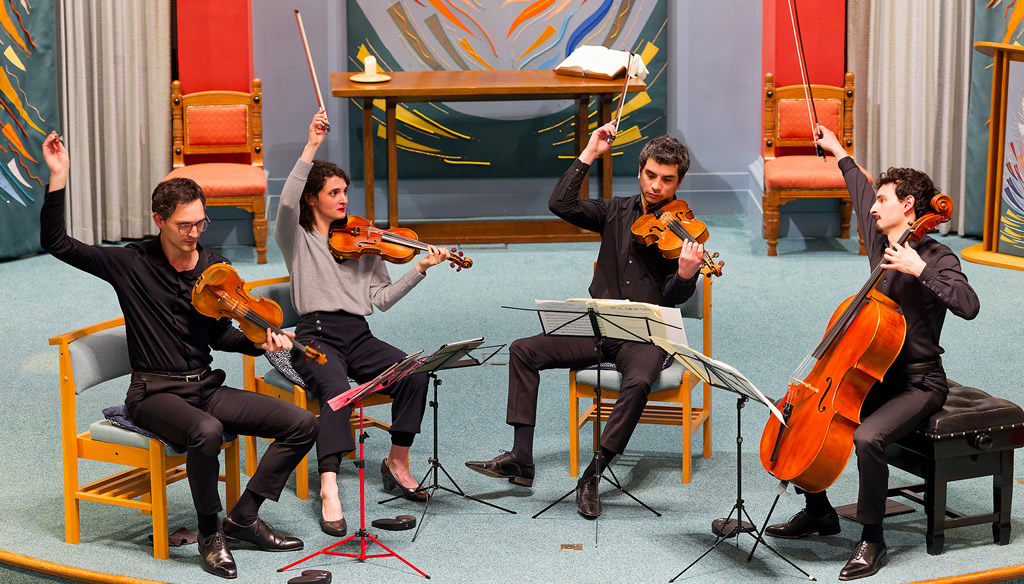
A spectacular start to the new year
The Music Club’s first concert of 2026 got off to a spectacular start with a high octane performance by the Quatuor Tchalik – normally, and extraordinarily, a string quartet of four siblings based in Paris. However, maternity leave for violist Sara Tchalik meant a replacement by Emmanuel François, who merged impeccably throughout their fine programme of Mozart, Reynaldo Hahn and Schubert.
Mozart’s Quartet in B flat K.589 was written after he visited Frederick Wilhelm II, the cellist King of Prussia. The opening bars immediately revealed a full, clear quartet texture that allowed each voice to project when needed. Cellist Marc Tchalik in particular brought out the bass line with telling ease in the first movement and when announcing the Larghetto’s expressive opening theme. The strange accents and bustling passage work in the unusually long Trio section were imaginatively despatched by violinists Gabriel and Louise Tchalik and the brisk tempo of the finale produced a virtuoso display of precise ensemble.
Reynaldo Hahn waited till he was 65 before writing his first quartet in 1939. Gabriel Tchalik introduced it with enthusiasm and the large audience clearly enjoyed this unfamiliar piece. The first movement alternated between a brooding theme that swept by and a livelier motif in agreeable harmonic language. The second movement gave the cello a Provencale folk song and the viola began the third, unaccompanied, in sombre mood and expressively played. The finale went helter-skelter from start to finish – a romp that only exceptional players could cope with
Schubert’s Death and the Maiden quartet is a permanent favourite in the quartet repertoire and the Quatuor Tchalik’s performance was a tour de force. From its dramatic opening the audience was treated to all of Schubert’s changing moods. The first two movements are both on a large scale; the uniting of drama and Viennese lilt was achieved with fine abandon, then sensitive tone and phrasing, particularly from the inner parts. The theme and variations revealed an even wider canvas – all four players engaged. The brief Scherzo flashed by before the tarantella finale crowned the evening’s performance – a breathless and invigorating experience.
John Upson